Kard Kulture

Not every idea should become the same flashcard

Turn your material into something worth studying.

Upload a lecture, a chapter, your notes or a PDF. Kard Kulture reads what is in it and builds a deck shaped around the ideas — not a pile of identical cards.

A demonstration of one Kard, in four steps: show the answer, then rate it Not yet or Got it, then start again. Choosing a step shows what the app shows next.
Memory and Learning

The testing effect

— What retrieving does that rereading does not

Recalling something strengthens the memory more than restudying it does — even though the recall attempt feels harder and the restudy feels more productive. The effort of pulling the answer out is a large part of the learning.

From Memory and Learning · written by us

I don’t understand this

Back a few Kards later in this same session, and again soon after it.

Scheduled further out — and further again each time it keeps coming back.

A real Kard from Memory and Learning, one of the nine decks that ship with the app. Two buttons, and nothing else to learn.

Kard Kulture is in private testing and is not on the App Store yet. Early access is a link to somewhere else; this site collects nothing.

Start from what you already have

Lecture in. Study deck out.

A lecture PDF, slides exported as a PDF, photographs of a printed page or a whiteboard, text you paste, or an Anki package you already own. Kard Kulture asks two questions about how you want to study it, and then reads the material.

  • Import PDF
  • Use a photo
  • Paste text
  • Write your own

How should I study this?

  • AdaptiveRecommendedKard Kulture picks the best shape for each idea: plain recall, comparisons, decision paths, maps and sequences.
  • ClassicStraightforward question-and-answer Kards.
  • BuzzwordsFast recognition Kards: a cue on the front, the association on the back.

How much should it cover?

  • High YieldRecommendedThe material that matters most, as one coherent deck.
  • CompleteEverything the source teaches, with any gaps reported honestly.

Four ways in, and what each one costs

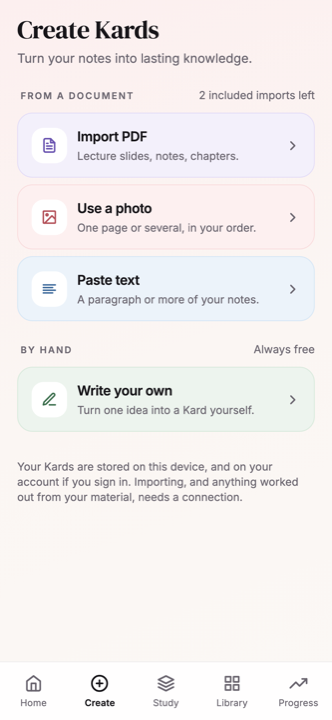
The allowance is on the screen before you spend it, not after. Writing your own Kards is always free and never counted.

The Create screen on iPhone: From a document, with Import PDF, Use a photo and Paste text, and an allowance reading 2 included imports left; below, By hand — Write your own, marked Always free.

It decides how many Kards the material deserves

Not a number you pick and not a fixed twenty. Kard Kulture reads the document and writes as many Kards as there are ideas in it, so a dense chapter yields more than a title slide.

Your Anki decks keep working

Import an .apkg and study it here, with the same scheduling as everything else. Kard Kulture is not a replacement for the deck you already trust; it is somewhere to bring it.

Adaptive

The format follows the idea.

Two things that are constantly confused are not one fact to be recalled. A rule with exceptions is not a definition. Where the material has a shape, Kard Kulture writes the Kard in it — which is a minority of Kards. Most of what you study stays Classic, and that is the right answer rather than a shortfall.

Split Compare

Standard deviation and standard error

— What each one is the spread of

Standard deviation

Standard error

Spread of

the observed values

the estimate across samples

With a larger sample

no systematic shrink

usually shrinks

Answers

how variable are the values?

how precise is the estimate?
Two ideas answering the same three questions, aligned.

Decision Path

Raising a maintenance dose

— What happens to the steady-state level

It depends on whether the enzymes clearing the drug still have spare capacity.

  • First-order eliminationThe level rises in proportion to the dose
  • Zero-order, saturated eliminationThe level climbs out of all proportion to the dose
A branch drawn as a branch, because “it depends” is the answer.

Seven structures ship. Each one exists because some kind of idea is badly served by a plain question and answer.

Decision Path
A branch, for when the answer is “it depends”.
Split Compare
Two ideas side by side, answering the same questions.
Visual Map
How several ideas connect, when the shape is the lesson.
Exam Coach
A trap or a distinction, set beside the ordinary answer.
Professor Margin
Notes in the margin around a main passage.
Pocket Sheet
A compact checkpoint over a group of Kards.
Minimal Recall
One sentence, and nothing around it.

That is the Kard, in the app

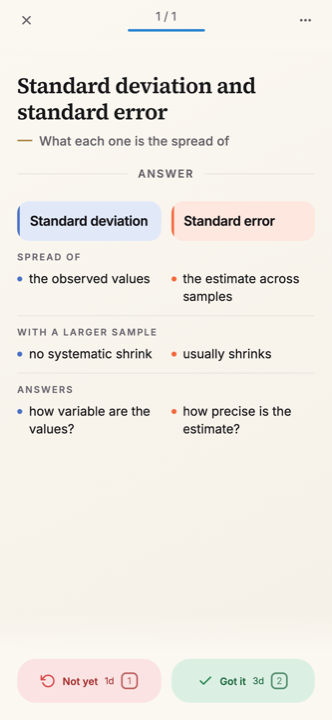
The comparison above is drawn here in HTML; this is the same Kard on a phone, in a real session. Question, answer, and the two ratings — nothing else on the screen.

A Split Compare Kard on iPhone: Standard deviation and standard error, with the two columns answering Spread of, With a larger sample and Answers, and the ratings Not yet and Got it at the bottom.

Any Adaptive Kard can be read as a Classic one. A structure is a way of showing a Kard, never a different Kard — so you can always set the layout aside and just see the question and the answer.

Buzzwords

See it. Know it. Move on.

Some material is not understanding, it is recognition: a phrase you have to meet and place in a second. Ask for Buzzwords and the deck is written as cues — the description on the front, the thing it should bring to mind on the back, big enough to take in at a glance.

  • Given by mouth, largely cleared by the liver before it ever reaches the circulation

    First-pass metabolism

    Pharmacology Patterns

  • A third factor that influences both the exposure and the outcome, making them look connected

    Confounder

    Statistics Without the Fog

  • A condition a structure guarantees is true before and after every operation on it

    Invariant

    Computer Science Foundations

  • Two membranes, its own circular genome, and where most ATP is produced

    Mitochondrion

    Cell Biology Foundations

  • Wants exceed what is available, so every use of a resource is chosen over another

    Scarcity

    Markets and Prices

  • The barrier a reaction must clear before reactants can become products

    Activation energy

    Chemistry Patterns

  • Reviewing an item just as it is starting to fade, at gaps that grow after each success

    Spaced repetition

    Memory and Learning

  • Found free in the cytoplasm and bound to a membrane, and builds every protein the cell makes

    Ribosome

    Cell Biology Foundations

Every one of those is a Kard in a deck that ships with the app, across seven subjects. Recognition is not a medical-school problem: an invariant in computer science and scarcity in economics are the same kind of cue.

Tutor

When a Kard doesn’t click, don’t just memorise it. Understand it.

One action on the answer side: I don’t understand this. Tutor breaks the idea down using the material behind your Kard — nothing to choose from, nothing to type.

A Tutor answer as the app sets it: the concept it is about, the one idea, the mechanism drawn as a chain, what matters, what this means for the Kard, what the material does not say, the pages it rests on, and the follow-ups offered underneath it.

Tutor

Vancomycin clearance

Why the dose follows clearance

Vancomycin leaves the body through the kidney, so how fast a patient clears it decides how much they can be given.

  1. Kidney function falls
  2. Vancomycin is cleared more slowly
  3. Each dose adds to what is still in the blood
  4. The trough concentration climbs

Toxicity risk rises unless the dose or the interval changes.

What matters

  • Weight sets the first dose; clearance sets every one after it.
  • A trough above 20 mg/L means the drug is accumulating.

Your material gives the rule but does not say what to do when clearance changes mid-course.

Renal Pharmacology — Lecture 7 · pp. 14, 22

  • Why?
  • Example
  • Quiz me

It makes the hard part followable

A mechanism in the order it actually happens. Two ideas that are easy to confuse, set side by side. Or just the one thing that matters. Something you can read and keep — not a conversation to scroll.

Built from your material

When a Kard came from a document, the explanation ends at the page it came from. A written explanation can still get something wrong, which is exactly why that page is there: check it rather than trust it. And it tells you plainly when your material does not answer the question — the one thing a general-purpose assistant never will.

Then keep studying

Ask why, see an example, or have it quiz you when you want another angle. Then back to the Kard you were on.

Grounding

Your material stays the source of truth.

A Kard generated from a document carries the page and the passage behind it, so you can check it instead of trusting it. Open the citation and the excerpt it was written from is right there.

Kards you write yourself, and Kards imported from Anki, have no document behind them — and say so rather than pretending.

Vancomycin clearance

— What sets the dose after the first one

Renal Pharmacology — Lecture 7 · p. 14

Vancomycin is cleared almost entirely by glomerular filtration, so the maintenance dose is set by creatinine clearance rather than by weight alone.

The citation is a footnote, not a badge. Open it and the passage is there, at the page it came from.

Scheduling

Study now. Remember later.

Every time you answer a Kard you say whether it came back easily. Kard Kulture learns how long each idea stays with you and brings it back just before it would have gone — so the hundred Kards you know well stay out of your way, and the nine you keep losing do not.

Not yet

Back within the same sitting, and soon after it.

Got it

Pushed further out, and further again each time it holds.

The forgetting curve

— Its shape, and what a review does to it

Steep at first, then flattening: most of what will be lost goes soon after learning, and what survives the first days decays slowly. Each successful review lifts the curve and makes the next decline shallower — which is why review intervals can grow.

The spacing effect

— Why the same hours spread out beat the same hours in one sitting

Reviews separated by time produce more durable memory than the same number of reviews massed together. On the usual account, each return after a gap has to rebuild the retrieval, and that effort is what makes the trace stronger.

Both of those are Kards in Memory and Learning, one of the decks that ships with the app. They are also the reason it schedules the way it does.

The scheduler is FSRS, the modern spaced-repetition algorithm. You never have to think about it: there are two buttons, and they mean what they say.

Test me

Recognising a Kard is not the same as being able to use it.

Reviewing is how you hold on to what you have learned. It is not a good test of whether you could apply it, because by the fourth time you have seen a Kard you are partly remembering the card.

Test me builds questions that put the idea somewhere you have not seen it — a case, a consequence, a comparison — from the same material your Kards came from. You find out what you can use, which is a different answer from what you can recall.

It is a check on your understanding, not a prediction of your exam. Nothing here estimates a grade.

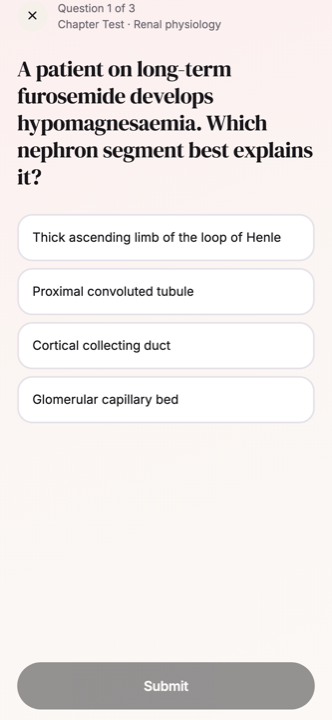
A Test me question on iPhone: a patient on long-term furosemide develops hypomagnesaemia, with four nephron segments offered as answers.

Deck Health and Search

A deck can be wrong in ways you will not notice while studying it.

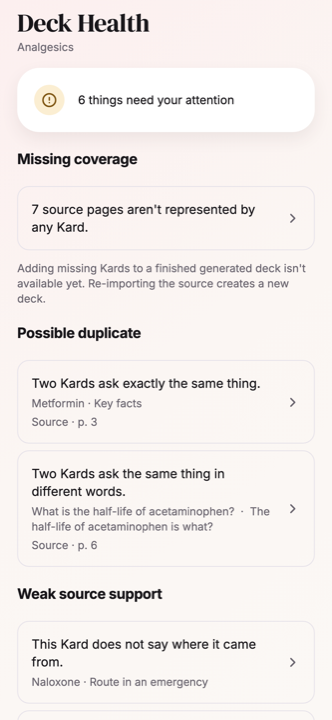
Two Kards that ask the same thing in different words. A Kard that does not say where it came from. Seven pages of the document that no Kard covers. Deck Health names each problem and takes you straight to it — no score to interpret, and several of them fixable where you stand.

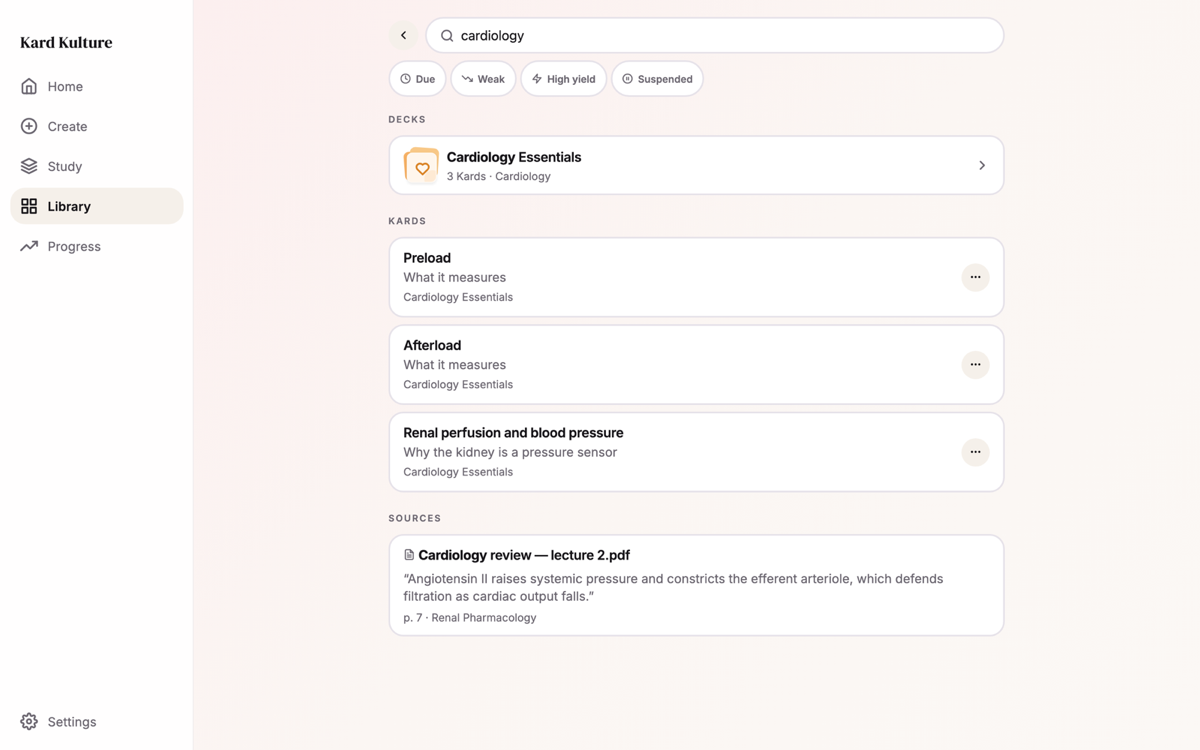
Search runs across your decks, the fronts and backs of your Kards, and the passages kept behind them. It runs on your device, it costs nothing, and it works with no connection.

Deck Health on iPhone: six things need your attention, listed as missing coverage, two possible duplicates, and a Kard with weak source support.
Search in a browser: the query cardiology, with results grouped into Decks, Kards and Sources, including a quoted passage from a lecture PDF.
Decks, Kards and the passages behind them — in one list.

The shelf

Start studying before you upload anything.

Nine decks ship with the app, written by us — eighteen to twenty-two Kards each, through the same quality checks an import goes through. Add one and study it in the next minute.

  • Physiology

    How the Heart Works

    One beat, from the impulse that starts it to the pressure it produces — the cycle, the wiring, the valves, and the rules that set the output.

  • Psychology

    Memory and Learning

    How a memory is made, why it fades, and which ways of studying the evidence favours — useful whatever you are studying.

  • Pharmacology

    Pharmacology Patterns

    The handful of ideas that explain most of what a drug does — binding, clearance, and the margin between working and harming.

  • Biology

    Cell Biology Foundations

    What the parts of a cell actually do, how information gets from gene to protein, and why the membrane decides what gets in.

  • Economics

    Markets and Prices

    Why prices land where they do, what a shift does to them, and the costs a price leaves out — the reasoning behind the diagrams.

  • Statistics

    Statistics Without the Fog

    What a p-value, an interval and a risk reduction actually entitle you to say — and the claims they never support.

  • Chemistry

    Chemistry Patterns

    Acids, electrons, forces between molecules and equilibrium — the few tendencies that decide what a reaction does.

  • History

    World History Connections

    Turning points and the conditions behind them — including which parts historians still argue about.

  • Computer Science

    Computer Science Foundations

    Structures, costs and invariants — why one data structure is fast where another is slow, in no particular language.

No document sits behind them, so there is no citation to open and no Tutor explanation to ask for — rather than offer either and then refuse. Everything else behaves as it does for a deck you made yourself. Nothing is rated or featured: the list is nine, and it does not grow.

iPhone, iPad and the web

Focused on iPhone. Spacious on iPad. Built for a keyboard on the web.

The same product on all three, composed for the screen it is on — a phone for between lectures, an iPad that holds a deck beside a Kard, a browser window with your library next to your work.

  • Studying works offline

    Once your Kards are on your device, studying does not depend on the internet. Making new ones does — generating Kards and asking the Tutor need a connection.

  • Nothing to set up

    An account is optional. Without one your library lives on your device and nowhere else; with one it follows you to your next device.

  • Nothing watches you

    No advertising, no third-party analytics in the app, and no trackers on this website. A document you import is deleted from our service ten minutes after upload, on a clock that is never extended.

Plans

Free to use. Pro for heavier terms.

The expensive part of Kard Kulture is reading your documents and building Kards from them, so that is the part that is counted. Studying, writing your own Kards and bringing in Anki decks are unlimited on both plans.

Free

  • Every one of the nine decks above
  • 2 of your own documents turned into Kards, included once
  • Unlimited study, and unlimited Kards you write yourself
  • Unlimited Anki imports

Pro

  • Bigger PDFs, more Kards per import, many more imports
  • Far more Tutor and Test me
  • Exam Rescue as often as you need it
  • Both Pro app colours

Before you ask

The four questions everybody asks first.

Does it just rewrite my slides as cards?

No. It reads the material for distinct ideas and writes as many Kards as it finds, in the shape each idea calls for. A page of bullet points does not become a page of Kards, and a dense chapter yields more than a title slide.

What if the material does not answer my question?

The Tutor says so. It will tell you plainly that your material gives the rule and not the reason, rather than filling the gap from somewhere else — which is the whole difference between a tutor that read your lecture and one that did not.

Can I use my existing Anki decks?

Yes, and without limit on either plan. Import an .apkg and the deck arrives with its cards, ready to study with the same scheduling as everything else. Scheduling history does not come across.

What happens to the documents I import?

The document is sent to our service and on to an AI provider, because reading it is the only way to make Kards from it. It is deleted automatically ten minutes after upload. A copy stays on your own device so a citation can open the page it came from, and that copy is never uploaded. The Privacy Policy lists every moment anything is sent, and what is sent.

You already have the material.
Make it worth studying.

Two imports are included free, along with every Kard style, the nine decks, unlimited Kards you write yourself, unlimited study and your Anki decks. An import that fails, or that your material cannot support, does not use one up.